


白夜追凶
Twin AI satellites fast-track China's global space partnerships_我的网站

一 |
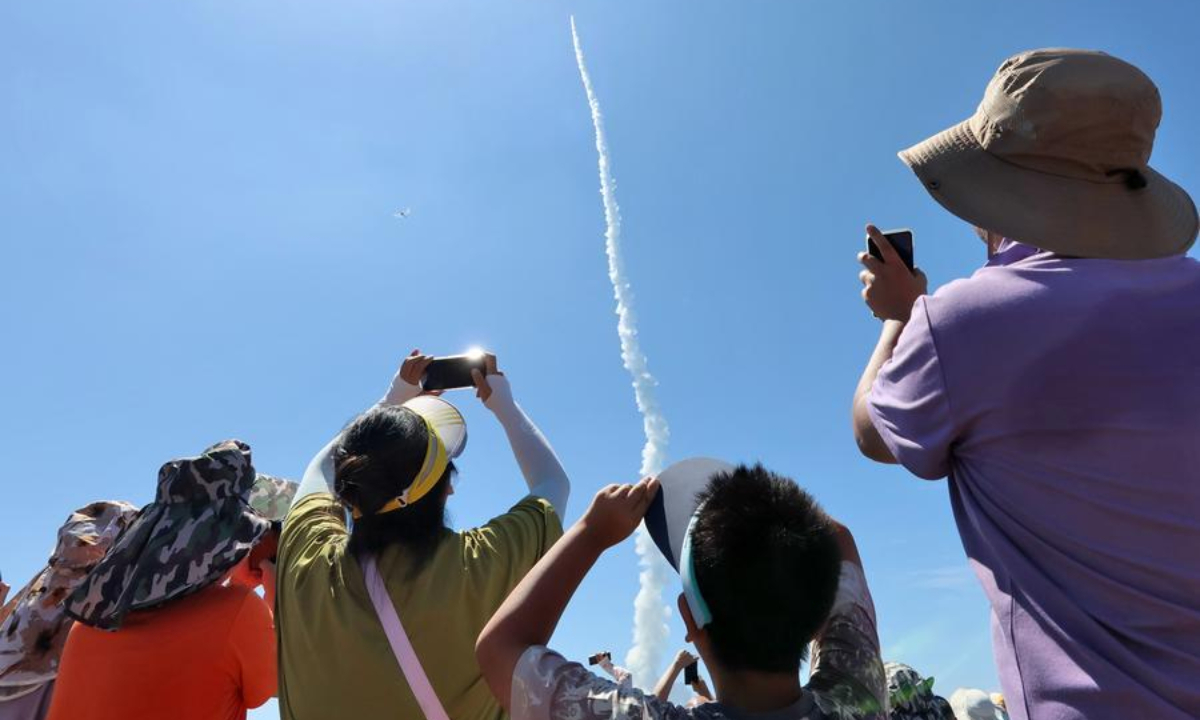
A burst of flame lit the morning sky over waters off Haiyang in east China's Shandong Province on Wednesday as a Smart Dragon-3 (SD-3) carrier rocket lifted off, drawing cheers from viewing sites along the coast.
Among the spectators were international students studying aerospace subjects in China. Aithana Perez, a Venezuelan aeronautical engineer studying space project management at Hangzhou Innovation Institute of Beihang University, said she and her classmates were excited because their studies involved spacecraft launch, design and operation.
For Marwane Oufrid, a 23-year-old Moroccan student in the same institute specializing in microsatellite technology, it was the first time he had watched a rocket launch in person.
The rocket blasted off at 10:38 a.m. (Beijing Time), delivering the Oriental Smart Eye hyperspectral satellites 01 and 02 into planned orbit.
In their respective cooperation projects with Indonesia and Uzbekistan, Satellite 01 is also known as Lampung-1 and Satellite 02 as Samarkand-2028.
Once in orbit, the satellites turned their attention back toward Earth. Lampung-1 is expected to monitor crop growth and disaster risks in Indonesia, while Samarkand-2028 is designed to support cotton cultivation and other land-monitoring applications in Uzbekistan.
Ordinary optical cameras mainly record the shape and color of objects. Hyperspectral imagers record a detailed spectrum for each image pixel, creating "spectral fingerprints" that can help determine the condition and composition of vegetation, water, soil and minerals.
These spectral "eyes" are paired with onboard AI computing modules capable of delivering up to 400 trillion operations per second. Instead of sending every raw image to the ground, the satellites can identify features, detect anomalies and extract useful information in orbit, potentially shortening delivery time from days to minutes.
Song Bingchen, co-founder of the Star.ai Spatio-temporal Intelligence Technology Co., Ltd., whose subsidiary STAR.VISION developed the satellites, compared the system to moving an AI inference platform from the ground into space.
"It changes the traditional model from transmitting images to transmitting results," Song said.
"Our satellite constellations are open to the world," Song noted, adding that the company welcomes international partners to jointly invest in, build and use the satellite networks.
In Indonesia, Lampung-1's planned applications are centered in Lampung Province on the island of Sumatra. Agriculture, forestry and fisheries accounted for 28.38 percent of the provincial economy in the third quarter of 2025. The satellite will also support marine resource management, environmental monitoring and disaster response.
Rahmat Mirzani Djausal, governor of Indonesia's Lampung Province, described the successful launch as a "historic moment" for the province.
"Cooperation with China on this satellite project is of historic and strategic significance," he said. "It marks the beginning of Lampung's transformation into a technologically advanced province."
The governor commended China's openness in sharing space technology and its commitment to long-term cooperation.
"China understands that any problems we face on one side of the world will ultimately impact the other side. Therefore, it is essential to empower regions that are left behind to make the world ultimately a better place," he said.
This cooperation also extends to people. Lampung is preparing to send over 100 young professionals to China for training in remote sensing and satellite communications, with the goal of building local capacity in satellite operation, data processing and spatial analysis.
In Uzbekistan, the applications center on cotton, grain and vegetation monitoring. Samarkand-2028 is designed to follow cotton cultivation from sowing to harvesting, while Uzbekcosmos has said hyperspectral data will also be used to produce national cotton and wheat maps.
Mukhiddin Ibragimov, deputy director of the Uzbekcosmos Agency, described the project as one of the largest international space projects in Uzbekistan's history and a milestone in its national space program.
He called the launch "a great occasion," saying it was the first time Uzbekistan had participated in an international space mission of such scale.
Ibragimov said Uzbekistan sent a technical team to China early in the project and formed a working group with Chinese specialists to develop an AI model for onboard data analysis. This model focuses on crop classification, including cotton verification, grain identification and vegetation monitoring.
The resulting data will support agriculture, water resource management, environmental protection and emergency monitoring, among other applications, he revealed.
Ibragimov said no single country can handle all space-related tasks alone.
"We believe that partnership brings value. We see that China is doing the same thing," he said, adding that Uzbekistan is exploring further satellite cooperation with China.
The projects offer a commercial example of the approach set out in China's 2021 space white paper, which called for international cooperation based on equality, mutual benefit, peaceful utilization and inclusive development.
Back in Haiyang, Oufrid said projects of this kind could give more countries an opportunity to participate in the space sector. He expressed the hope to see such cooperation happen more often and "maybe someday with Morocco as well."
。
[ 国内谍照] 日前,我们在工信部看到了理想i6车型申报图,新车采用与理想i8近似的外观设计,定位5座中大型SUV,计划将于将于9月上市。
友情提示:如果您有新车谍照/新车爆料,请点击编辑头像(仅限App)私信给我们,期待您的来信。
。
二 |
友情提示:如果您有新车谍照/新车爆料,请点击编辑头像(仅限App)私信给我们,期待您的来信。

三 |

四 | 车头仍然类似于高铁车头的流线设计,以降低风阻,前大灯组位于前包围处。

五 | 车身尺寸来看,新车长宽高分别为4950/1935/1655mm,轴距为3000mm。轮圈方面,新车提供20英寸和21英寸轮圈供选择。

六 | (文/ 李娜)
Current article:http://epiom.tandianxiuzhutiaoshoudiamei.pics/news/20260826_70207.html
Published on:00:55:42
 女子在家开台灯,遭楼对面邻居多次上门投诉:灯光影响孩子写作业;物业:已多次调解,双方均不认可调解方案,最终选择报警
 3个核心第一次同框合练!41岁詹姆斯已经开练,76人最难一课却不是战术
 霍尔木兹海峡通行商船数量降至3个多月以来新低
 US Navy destroyer in Red Sea shoots down cruise missiles potentially headed toward Israel: Pentagon
 木铎双星发射成功
 Apple AirPower无线充电器出现在iPhone XS的智能电池盒页面上。
 区领导调研文旅产业建设情况
 WTI原油期货价格跌幅扩大至3%
 Buzz: Sai Pallavi in Talks for MS Subbulakshmi Biopic?
 我国高能量密度一次电池功率获突破
 Video: Wildfires in Northern Morocco Destroy More Than 6,000 Hectares of Forests